
Smart Governance in China:
Infrastructure and Real-Time Percepcion
In brief
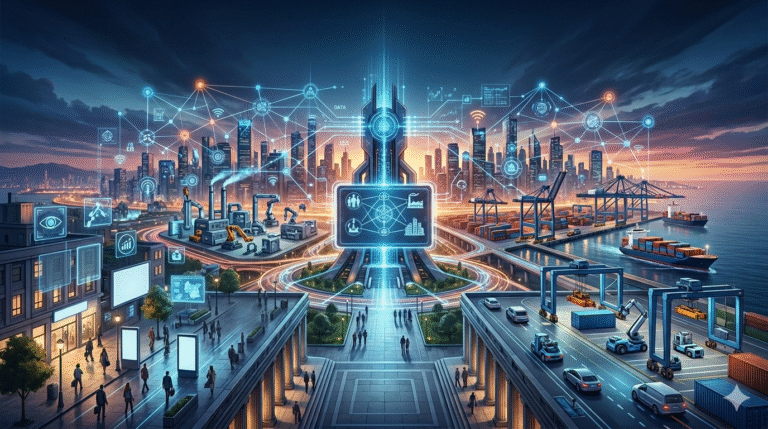
Smart governance can be understood as an operating architecture in which continuous perception, automated analysis and decision support converge across specific sectors and use cases.
When those layers close fast loops between data capture and response, infrastructure or territory can become more legible and more interpretable for operators, although the resulting precision depends on data quality, interoperability, institutional coordination and the quality of the underlying governance model.
China is modernizing ports, factories, cities, and energy networks. In doing so, it is showing that whoever masters this capacity for territorial reading gains room to anticipate, correct, and manage under pressure.
Introduction:
when territory becomes legible
In Shenzhen and a limited number of other leading Chinese cities, traffic analysis systems have combined cameras, real-time data, and congestion history to anticipate incidents and support operational responses. This is smart governance in operation: territory translates its signals into data, data is translated into patterns, and patterns make anticipation possible.
Smart governance is not a collection of disconnected technological tools, but an architecture in which continuous perception, automated analysis, decision support, and, in some cases, automated execution converge within the same system. In this sense, what makes the Chinese case especially instructive is that these components form part of a broader operating logic: reading territory as a system of signals that makes precise action possible.
Because this architecture is not confined to one sector, its value appears most clearly in infrastructure-heavy domains such as cities, ports, energy, water and emergency management. For Europe, which faces growing pressure in territorial complexity, resource efficiency, and operational resilience, understanding how China organizes this capability is essential for designing its own governance architecture.
The four layers of smart governance
Layer 1: Distributed perception
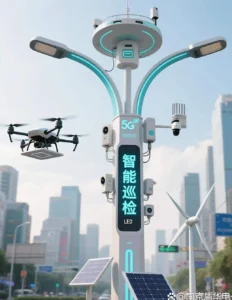
The perception layer is the foundation of any smart governance system. It combines fixed networks of sensors, cameras, weather stations and smart meters with mobile extensions such as robots and drones equipped with perception systems. In practice, fixed infrastructure provides continuous baseline coverage, while mobile systems help confirm anomalies or increase resolution where needed.
From a European perspective, the same layer that improves operational awareness can also intensify concerns around privacy, proportionality, surveillance and lawful access to data.
Layer 2: Processing and analysis
Data alone is not enough; in order to extract valuable information from it, it needs to be processed, turning it into operational capacity. That only works if the underlying data are timely, interoperable and complete enough for the task, for example in models that combine meteorological variables with risk histories or recognition systems that detect anomalies.
This layer is deployed in distributed form: in local analysis stations, in servers located close to infrastructure, or in central platforms that aggregate and synthesise.
Layer 3: Automated decision support
When the system detects a condition, it can trigger alerts, recommend responses and pre-structure action; however, in most public contexts, the final decision should remain human, especially where rights, safety or accountability are at stake.
For example, if sensors detect flow changes suggesting a potential leak in a dam or the overflow of a river, the system does not simply issue a generic alarm: it calculates where to inspect, what the estimated risk is, what resources would be needed, and which geographic area could be affected. The infrastructure manager receives a synthesised view that can support emergency protocols, but the system’s recommendations remain dependent on model accuracy, sensor reliability and the quality of situational interpretation.
Layer 4: Integrated execution
Once the decision is made, its implementation works like a distributed nervous system, with transport, energy, security, or logistics systems coordinating in real time.
This way, autonomous machinery systems integrated with connectivity and positioning can carry out complex tasks: repairing an electrical line where an anomaly has been detected, reconfiguring traffic routes when congestion arises, or activating emergency mechanisms when the population is at risk. All of this can happen without waiting for human intervention at each step. The system adjusts its behaviour while it is executing, refining its response as the situation evolves.
How it works in practice
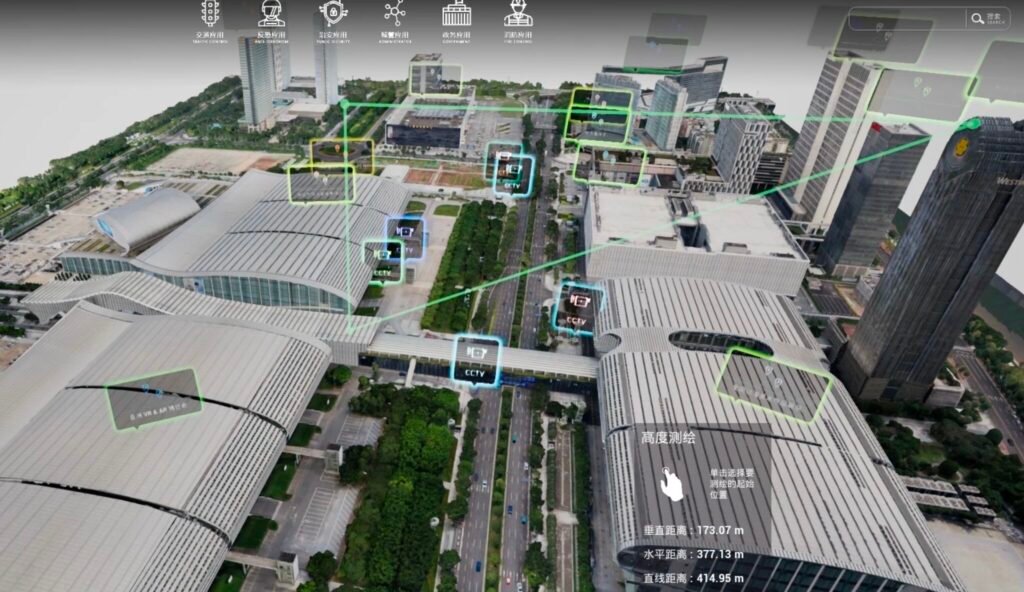
A recent visit to the Canton Fair complex offered an illustrative example of coordinated territorial management in a large mixed-use system. The case shows how perception, analysis, decision support and execution can be linked across mobility, security and service operations, although the degree of integration varies by subsystem.
Perception: Sensors across the Fair spaces register attendance, flows of people, and intensity of use. Cameras detect anomalies and recognise behavioural patterns. Transport systems record demand in real time. Ports and airports provide information on incoming flows.
Analysis: Algorithms cross-reference that data. Is attendance in Hall A above expectations? Which transport routes are reaching capacity limits? Are there anomalies in cargo flows at the port of Guangzhou that coincide with activity at the exhibition complex? Which service needs — such as energy, water, or security — are growing faster than expected?
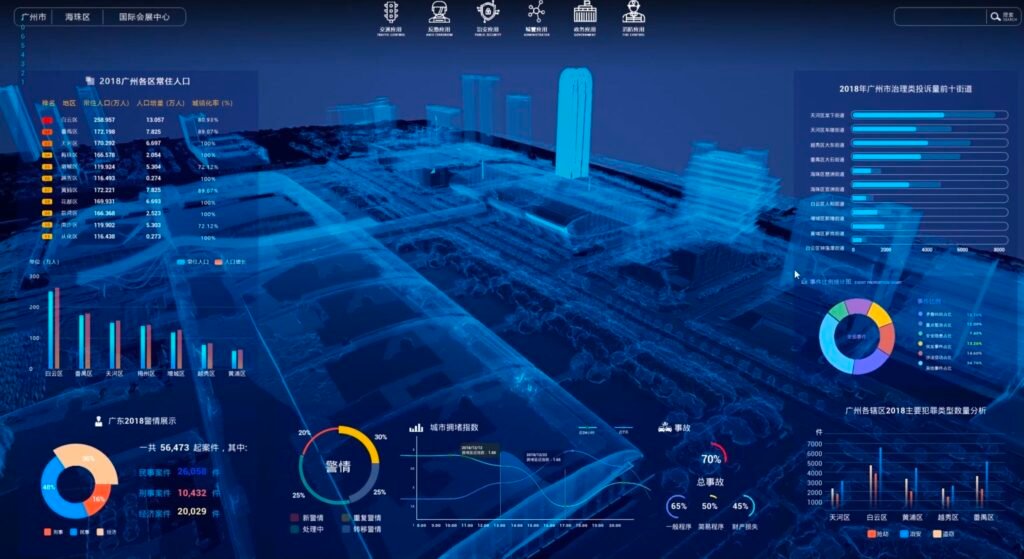
Decision: In the best-integrated cases, operators can access a unified or semi-unified interface that brings together key operational indicators. An operator can see in real time where there is congestion, where resources are idle, and where risk is emerging. The system proposes flow reconfigurations, activation of additional services, and traffic diversion. The operator decides on the basis of data, not abstractions.
Execution: Once decisions are made, transport vehicles receive instructions, energy systems adjust distribution, security staff are redeployed, and charging stations for vehicles are activated. This interface also includes emergency-response protocols for different types of scenarios, such as fire or a terrorist threat. In such cases, the system identifies indicators of danger and sends an alert to the security forces, which receive concrete information and visual support to coordinate the response. All of this happens with continuous correction as the situation evolves.
Beyond trade fairs, the same logic becomes especially relevant in ports, energy and water systems.
Transversality: why this matters beyond cities
Ports: continuous reading of complexity
An industrial port is a complex ecosystem in which hundreds of simultaneous movements and thousands of interdependent variables interact: ships arrive with containers, those containers are unloaded, and they are distributed inland under different traffic and weather conditions.
Through an integrated smart governance system, a port can reduce container dwell time and improve coordination among cranes, autonomous vehicles and storage.
Energy: dynamic balance
Power networks must stay balanced minute by minute, especially as renewable generation becomes more variable.
Smart governance can bring the system closer to balance: using sensors to monitor demand in real time, adjusting distribution accordingly, anticipating peaks based on historical patterns and weather forecasts, and activating fast-response resources such as batteries or flexible generation plants precisely when they are needed.
Water: territorial management of a critical resource
A digital twin (a simulation model that replicates the behaviour) of a water-distribution system, integrated with real-time consumption data, meteorological data, and infiltration and loss data, enables managers to decide where to invest in repairs and where the risk of scarcity is increasing.
For a country like Spain, where water stress, seasonal demand and territorial variability are structural, this capacity to read the territory and anticipate pressure should be treated as critical infrastructure governance rather than as a technological luxury.
key idea
Smart governance works as a closed loop: continuous perception of territory, analysis that detects anomalies and patterns, decision with automated support, integrated execution, and feedback that makes it possible to learn, optimize, and exercise control. When that cycle is fast and highly integrated, uncertainty is reduced and the capacity to act on complex realities grows.
What this reveals about China’s industrial capacity
The fact that China has drones, sensors, and automated analysis systems is not new.
What is becoming distinctive in some leading contexts is China’s capacity to organize territorial complexity. That is possible when regulation, industry, research, and implementation advance with coherence and institutional coordination, as China’s broader governance and data strategy suggests. It also requires connectivity standards, that allow machines and systems to communicate, as well as deployment capacity.
Why this is important for Europe
The question for Europe is how to adopt these technologies in a way that fits its legal and institutional context, without creating new dependencies, weakening fundamental rights or importing closed governance models that would be politically unacceptable.
That requires, at a minimum, four conditions:
- Technical capacity: Europe must be able to produce, integrate and maintain its own sensors, analysis platforms and coordination systems as critical infrastructure, while also building the talent base required to deploy and govern them effectively.
- Control over critical components: Connectivity standards, communication protocols, and positioning systems must be accessible and not depend on a single provider. This is where Galileo, Europe’s positioning system, and open 5G, not dominated by a single actor, become important.
- Clear regulatory frameworks: We need explicit rules on what data is collected, who can access it, and under what conditions. Europe has GDPR, but it also needs frameworks that regulate intelligent territorial governance without paralysing it.
- Connected industrial ecosystems: Manufacturers of sensors, analysis software, autonomous machinery, and data platforms must be able to work in an integrated way, not each within its own silo. That is more an organisational challenge than a technological one.
It is important to note that the same infrastructures that improve coordination can also concentrate power, expand surveillance and create dependence on proprietary systems. For Europe, the challenge is not to imitate the model, but to extract the operational lesson while preserving democratic control.
Conclusion
China is showing that when perception, analysis, decision, and execution close fast cycles within the same system, territorial complexity becomes legible, interpretable, and controllable.
For Europe, the question is urgent: what kind of governance architecture do we want to build? Not as an imitation of the Chinese model, but as our own alternative, one that optimizes resources while also integrating our standards of transparency, data protection, and democratic decision-making.
The real competition lies in territorial capability, institutional coordination and implementation capacity. Europe can still build its own model, but only if it combines investment, regulatory clarity, procurement reform, data governance and operational pilot-to-scale mechanisms.

Do you need to understand how to structure smart governance with European technological sovereignty?