
Smart Agriculture in China:
Reading the Land to Govern it
In brief
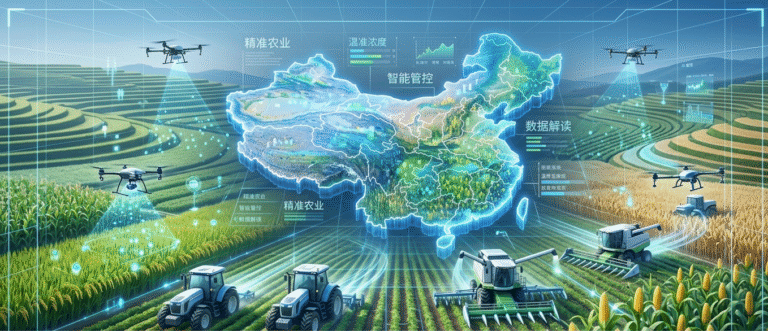
In China, agricultural drones now exceed 300,000 units and their annual operational coverage has surpassed 460 million mu, showing the scale at which this model is already operating.
Agricultural technology is not simply about deploying drones, tractors, or the most advanced sensors. It is about a territorial architecture that makes the countryside more legible, more interpretable, and more governable. When perception, automation, data, and rapid decision-making converge within the same system, agriculture stops being just a productive activity and begins to take shape as a form of territorial intelligence. And that is where an important part of China’s advantage lies: not only in the machines it deploys, but in the way it organizes territory so that it can read it and act on it with precision.
Introduction
For a long time, agricultural technology was understood mainly in terms of machinery, apart from biotechnology and other inputs: more powerful tractors, more efficient irrigation systems or tougher tools. That image is still valid, but it is no longer enough to describe the current reality.
What is changing in China is not the machine alone, but the way the countryside is being turned into an operational system of sensing, analysis and intervention. Agriculture is becoming less dependent on mechanical force and more dependent on the quality with which a system can detect variation and act precisely.
That is why China is so revealing for Europe, where fragmented land ownership, water stress and slower integration of sensors, software and field deployment still limit scale. The broader lesson is not just about agriculture, but about territorial governance.
When cultivation stops being a homogeneous expanse
Smart agriculture often begins when a crop stops being treated as a uniform surface.
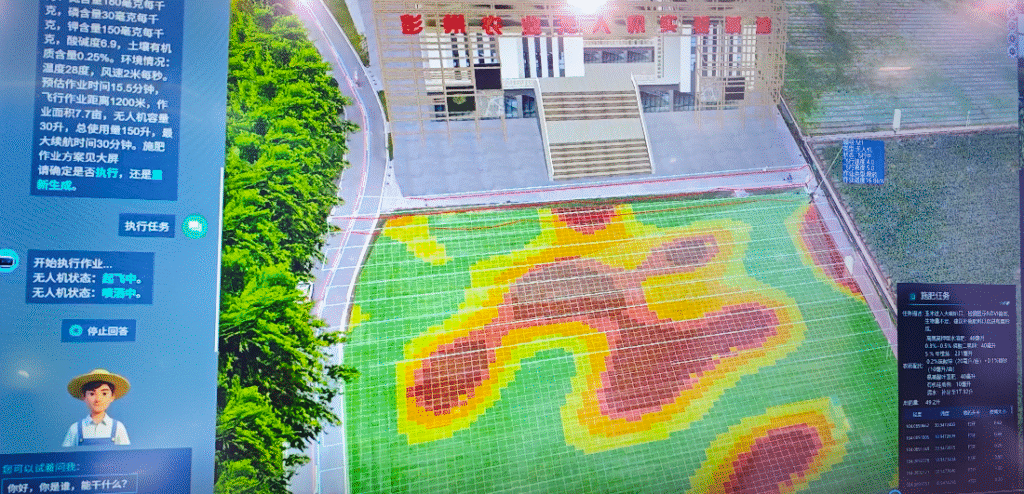
When the land is perceived as a homogeneous expanse, intervention also tends to be homogeneous: the same irrigation, the same treatment, the same logic across the whole plot. But once the terrain begins to be measured in differentiated layers — moisture, temperature, density, height, crop stress, pest presence — differentiated intervention becomes possible. And that is where the intelligence of the system truly begins.
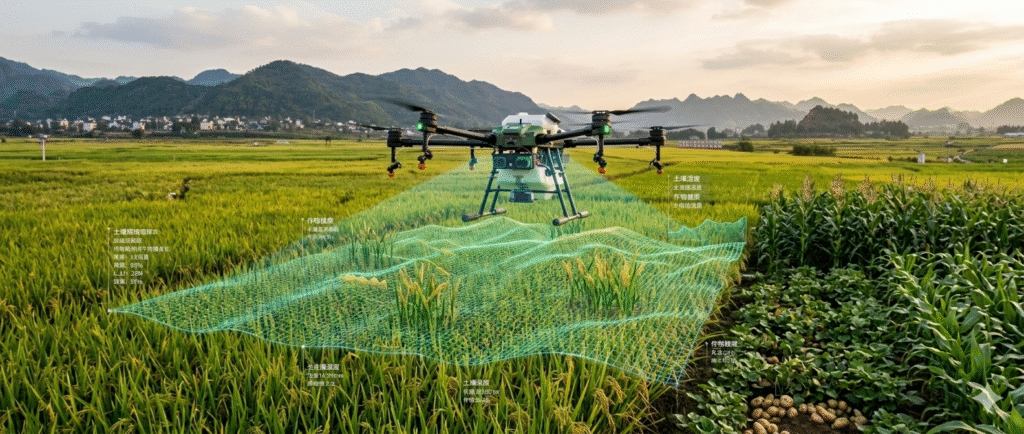
China operates more than 200,000 agricultural drones, with annual coverage of more than 26 million hectares. But the importance of this fact does not lie in the number itself. It lies in what that drone network is measuring: equipped with light sensors, thermal cameras, LiDAR, and recognition software, it forms a layer of continuous perception. These machine senses —cameras, thermal sensors, depth reading— cease to be a complement and become the foundation of the architecture.
Without that perceptual layer, we are not really talking about smart agriculture, but about machines executing orders independently.
key idea
A smart territory does not begin with advanced machines. It begins when it becomes legible: when every plot, every variable, and every anomaly can be detected and connected to other signals.
From measurement to differentiated intervention
A smart agricultural system does not merely observe. It intervenes better.
If it detects an area with a moisture deficit, it can activate differentiated irrigation; in some Chinese smart fields, drones transmit real-time data to a central system that generates 3D maps and AI models then issue precise irrigation and fertilization instructions.
If it identifies specific weeds, it can treat them without spreading chemicals across the rest of the plot. If it recognizes variations in crop vigor, it can adjust inputs, routes, and timing. Precision stops being a technical improvement and begins to reorganize the logic of intervention itself.
With Beidou and 5G technology, some Chinese autonomous tractors operate with centimeter-level precision, adjusting routes and dosage levels without direct human intervention. That means less overlap, less waste, lower water consumption, fewer chemicals, and less energy use.
It also means something deeper: a greater ability to govern variables that, for decades, were simply too complex, too unstable, or too costly to manage at that level of detail.
That is where this technology begins to acquire strategic value, because what improves is not only performance: it is the ability to read and control a biologically variable territory.
In other words, what improves is the ability to govern agricultural reality in all its variability.
Coordinated territory: Qingdao as a diagnostic image
China is integrating perception, machinery, data, software, and logistics within the same operating architecture.
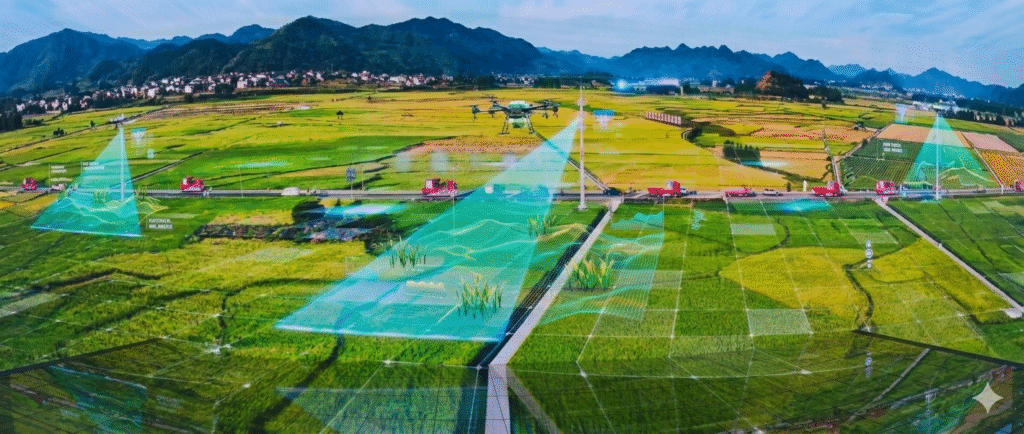
In Qingdao, Shandong, more than 16,000 units of smart agricultural machinery operate in coordination, not as isolated machines but as parts of an adaptive territorial system. Crop-protection drones carry out low-altitude pesticide spraying, while integrated water-and-fertilizer systems deliver nutrients on demand with precision. All of this is connected to on-site weather stations and pest and disease monitoring equipment.
This is what distinguishes these systems: the ability to connect innovation, manufacturing and territorial deployment with very little friction. Local reporting says production efficiency has risen by more than 15 percent versus traditional methods.
Beyond production: water, resilience, sovereignty
China’s development of this capacity is not merely an agricultural matter. It is strategic.
We are talking about water, food resilience, territorial management, and the ability to sustain production under demographic and environmental pressure.
But we are also talking about something broader: a country’s ability to reduce uncertainty in one of the most sensitive areas of any society. When a state masters the use of IoT sensors, agricultural software, autonomous machinery, and control systems in the countryside, it does not just produce more effectively. It understands its own limits and capabilities better. It gains room to anticipate, correct, and sustain. And of course, it also gains the ability to export solutions, standards, and know-how.
The Chinese government has set the goal that a substantial share of its large-scale farms will use AI-powered equipment by 2030. That is not merely an agricultural figure. It is a statement of intent about what kind of capability, what kind of territory, and what kind of governance the country wants to build. Because when agriculture is organised as an integrated territorial system, it ceases to be only about production and begins to function as a form of territorial governance. The same sensors, drones, and data that optimize a crop can also inform water policy, land-use decisions, and regional climate-adaptation strategies.
What this reveals
Advanced agricultural technology exists in many countries. But in China, one feature stands out with particular clarity: the ability to integrate that technology into broader systems in which innovation, manufacturing, data, connectivity, and territorial deployment reinforce one another.
Smart agriculture is not about mechanizing the countryside more effectively. It is about turning it into a system that can be read, interpreted, and governed on a continuous basis. The territory is no longer a place where things merely happen. It becomes a text that can be deciphered and acted upon with a high degree of control.
The deeper question is not whether China will produce more, but whether it can turn its agricultural territory into a system that is legible and controllable enough to withstand demographic pressure, water stress, and climate volatility without collapsing.
The question for Europe
The real question is not whether Europe should compete drone against drone or tractor against tractor, but whether it can build field-level integration across sensors, software, water management and machinery.
The Chinese model suggests three lessons.
Territorial perception. You cannot govern what you do not measure. In irrigated agriculture that means plot-level data on soil moisture, crop stress, and water demand. In Spain, where 7.9 million hectares are irrigated homogeneous management wastes potential. Improving territorial reading capacity — soil-moisture sensors, plot-level performance analysis — is not a technological luxury. It is survival in a context of structural drought.
Differentiated intervention. Better irrigation does not mean more irrigation; it means irrigating where it is needed, when it is needed and in the right amount. That requires integration between weather data, soil data, crop-demand data and historical yield records.
Integrated territorial governance. Regions such as Andalusia or Castilla-La Mancha would benefit greatly from systems that connect sensors, drones, historical data and climate predictions. That requires not only technological innovation, but also industrial capacity and coordinated deployment.
In a territory where water is the limiting factor, agricultural technology becomes a matter of food sovereignty and water resilience.
Conclusion
Agricultural technology in China points toward a new relationship between territory, intelligence and execution. It is not simply about having more advanced machines; it is about learning how to read the countryside as a system of signals, data and decisions, and acting on that reading with speed and precision.
For Europe, the challenge is not to copy the Chinese model, but to understand what it reveals: smart agriculture is an indicator of a country’s ability to read its territory, anticipate pressure, improve self-sufficiency and execute complex responses at scale.
The deeper question is which countries can turn productive territory into a more resilient system under water stress and climate volatility.
In that sense, China is establishing new patterns of territorial and industrial organization that are worth observing and, where useful, reinterpreting in our own context.
Would you like to explore how your technology could help your territory or agricultural business improve performance?