
Dexterous Hands:
Intelligence at the fingertips
In brief
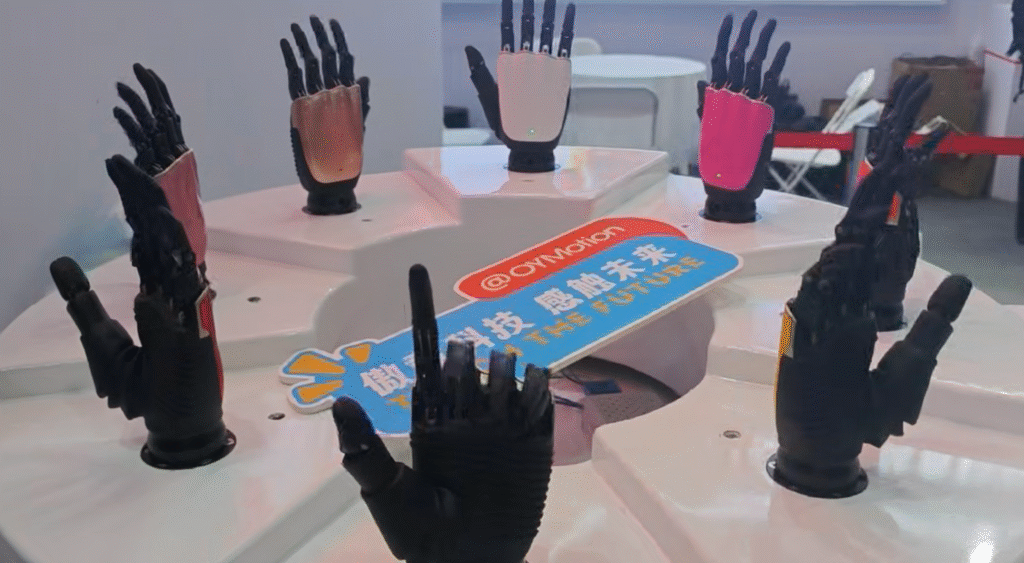
Dexterous hands bring together, within a single system, many of the key elements behind China’s technological development: sensing, advanced materials, control software, learning, rapid integration, and functional adaptation. They are not just an accessory attached to a robot, but a very clear expression of how China combines technical modules within a broader execution architecture. Their value lies not only in what they do, but in what they reveal: a way of organising capabilities, transferring solutions across sectors, and reinforcing a form of functional sovereignty based on critical, reusable technologies.
Introduction
If a robot captures an entire technological architecture, a robotic hand condenses almost all of it.
In a relatively small component, precision mechanics, advanced materials, sensors, software, control, perception, learning, and industrial capability all come together. That is why looking at the development of so-called dexterous hands in China is not simply about examining a robot accessory. It is one of the clearest ways to see how the country turns technical modules into functional solutions. And here, once again, an idea I have observed repeatedly over the years in China comes back into view: what matters is not only the final product, but the ecosystem that makes it possible to design, adapt, manufacture, and deploy it.
A piece that condenses
an entire system
We tend to think of the robotic hand as a possible end point of a robotic arm. In reality, it is better understood as a highly complex technical organ. Because grasping well is not just about closing a set of fingers. It means calculating force, detecting texture, correcting deviations, adjusting pressure, recognising shapes, anticipating slippage, and adapting the gesture to the context.
That helps explain why these dexterous hands say so much about industrial capability. Building them properly is not just a matter of having a decent shell or acceptable motors. It requires integrating a wide range of elements, such as sensors, actuators, flexible materials, adhesive surfaces, control systems, and training methods, along with a network of suppliers and services able to iterate quickly. Put differently, a well-developed robotic hand is not only a piece of engineering; it is proof of an execution architecture.
How they are built
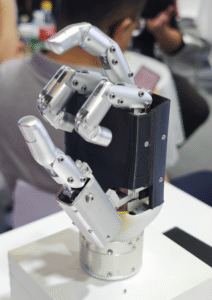
A dexterous hand is built through several layers that have to work in coordination.
On the one hand, there is a physical structure made up of different mechanical components and materials adapted to the intended use. On the other, there is a sensory layer that makes it possible to detect pressure, force, contact, position, or slippage. Added to that is a control layer, responsible for coordinating movement and adjusting interaction with the object. And increasingly, there is also a layer of learning and adaptation, supported by systems such as teleoperation, camera-based vision, haptic gloves, or different training environments. The robotic hands I have observed in China often incorporate fingertip sensitivity, multi-axis force sensors, and soft, flexible materials to improve grip and precision.
That combination matters because it reveals something broader: China is not just developing “hands”, but reusable capabilities. The same principles of fine control, sensing, precision movement, and material adaptation can reappear in prosthetics, robotic surgery, logistics, industrial inspection, defence, or commercial automation. That is one of the keys to China’s industrial system: it does not advance only through closed products, but through recombinable modules that can move from one sector to another.
That is why, in my analyses and reports, I often describe the Chinese model as a dense, modular architecture designed to recombine industrial functions quickly.
Key idea
A dexterous hand is not just a piece of engineering; it is proof of an execution architecture.
Function Matters More Than Form
Another common mistake is to imagine one ideal form: a five-fingered humanoid hand. The reality is far more interesting.
In China, one can see a wide variety of configurations: robotic grippers, two-, three-, four-, five-, six-, or seven-finger hands, tentacle-like forms, soft designs for delicate objects, and industrial configurations that are completely removed from human anatomy. Some imitate the morphology of the human hand because they need to reproduce human dexterity. Others do not seek to look human at all, but simply to solve a task in the most effective way possible. In this field, form matters less than function. The key is not the shape, but the functionality.
And this points to something deeper. Chinese robotics does not seem overly attached to the symbol of the humanoid for its own sake. The approach is usually more pragmatic: if a gripper solves the task better, a gripper is used; if five fingers are needed, five fingers are designed; if a certain environment only requires a non-anthropomorphic geometry, then human resemblance is set aside. This logic is not unique to China and has existed for a long time in many industrial settings. But in China it often appears with particular clarity and at scale: the starting point is not an ideal form, but the most effective solution for each function.
The touch is the real frontier
The important leap is not so much adding more fingers as enabling the hand to “feel”.
A dexterous hand must do more than open and close. It needs to know how much force to apply, when to correct, whether the object is slipping, whether its surface is hard or soft, and whether posture or force distribution should be adjusted. That is why sensors and textures matter so much. Pressure and force sensors in the fingers, soft materials to improve grip, surfaces designed for different types of contact, and software able to interpret all of this in real time are what turn a clumsy system into a truly precise hand. These hands do not just grasp; they understand, adjust, and learn.
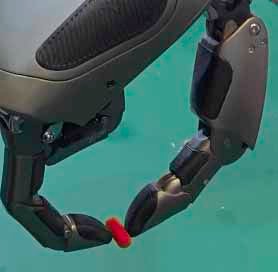
A large part of the future of the field will be decided here. The better artificial touch becomes, the more capable these hands will be when handling electronic components, assisting in surgery, picking fruit without damaging it, operating in laboratories, loading irregular goods, working in nuclear facilities, or delivering items in commercial and logistics settings.
How they are controlled:
from software to intention
It helps to bring some order here, because several methods overlap. I would group them into five broad families.
The first is the most traditional: software control and direct programming. A specific instruction, sequence, or task is given to the hand, and the system carries it out within certain parameters, which can be adjusted when necessary. This remains essential in industry, logistics, and repetitive automation.
The second is teleoperation by demonstration: methods such as sensor-equipped gloves, camera-based visual tracking of the hand, or haptic interfaces that allow a human gesture to be transferred to the robotic hand, speeding up training, calibration, and adaptation.
The third family is made up of traditional controllers: remote controls, joysticks, virtual reality controllers, or even adapted videogame controllers. They are not the most sophisticated option, but they remain useful because of cost, familiarity, and speed of deployment, especially in testing environments, training, or simple teleoperation.
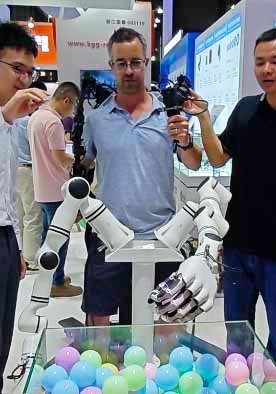
The fourth family is the bioelectric interface. Here, what is translated is no longer a visible gesture, but the user’s physiological signals. This is the case with advanced prosthetics that read muscular impulses or tensions in the muscles and tendons of the part of the arm that remains after amputation. During my visits to BrainCo, a technology company I know well and with which I maintain a close relationship, I have seen hand, leg, and foot prosthetics respond to muscular impulses detected by sensor-equipped armbands. It is one of the most interesting developments because it turns the robotic hand into a functional extension of the body. One particularly revealing detail is that these hands can be detached from the arm and still replicate the intended movement when the user activates that intention through the armband.
The fifth family is the neural or brain-machine interface, which is even more advanced. Here, movement begins to be translated from brain signals, bringing us closer to a form of control in which the boundary between prosthetic, robot, and cognitive interface becomes increasingly blurred. I have also seen developments aimed at this kind of brain-machine connection: robotic hands and other systems that can respond to brain signals in order to control movements or operate machines. It is worth being cautious about the exact maturity of each solution, but the direction is clear: robotic control is moving progressively from external instruction towards intention.
They can also act autonomously
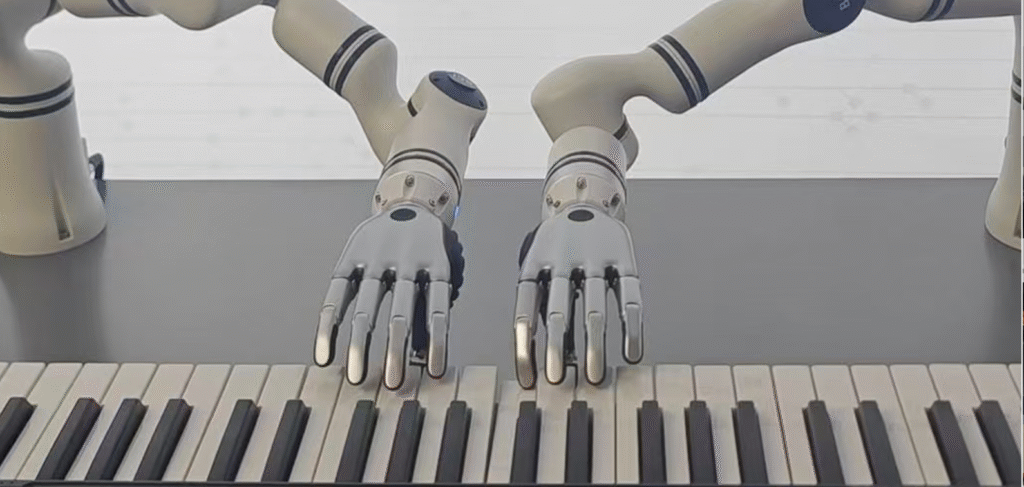
There is another equally important layer: autonomy.
These hands do not always wait for detailed human instructions. In many cases, they are equipped with cameras, sensors, and perception software that allow them to detect the object, estimate size, distance, orientation, weight, fragility, or contact conditions. From there, they adjust grip, force, and trajectory. A hand cannot be separated from the sensory and cognitive system that supports it. Perception, control, and action are part of the same continuum.
That is why a dexterous hand should never be analysed in isolation. It is the convergence of multiple elements, including machine vision, sensing, precision actuators, control software, applied AI, and training. And this is where one can clearly see how China integrates AI, robotics, and advanced manufacturing within its technological and industrial ecosystems.
From the factory to the clinic, from commerce to defence
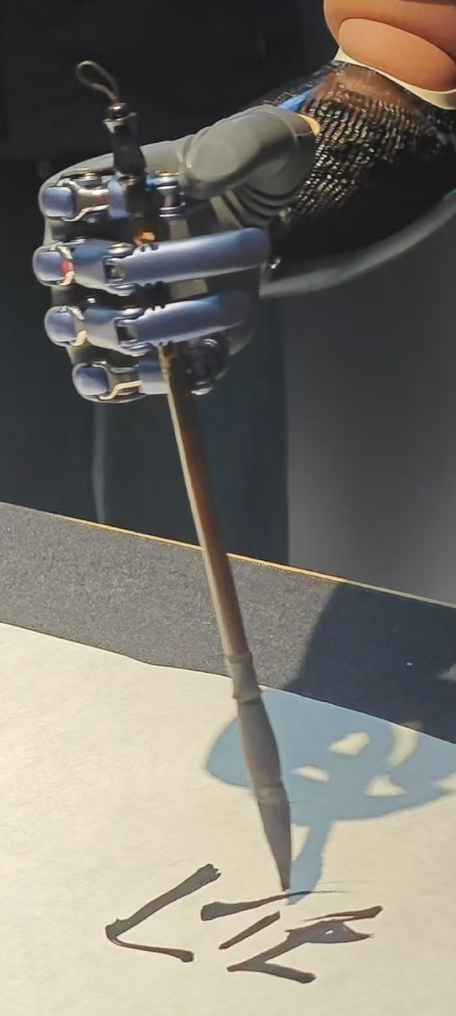
The applications of dexterous hands are much broader than they may first appear. Their uses range from electronics assembly to robotic surgery, prosthetics, commercial automation, and service robotics. Over the years I have spent in China, I have seen, for example, robot-operated shops, coffee and ice cream vending machines, and pharmacies where a robotic arm delivers the product after payment.
But the real reach goes much further. These hands can be decisive in defence and military training, in risky tasks such as explosives handling, in the maintenance of critical infrastructure, in chemical laboratories, nuclear plants, automated logistics, precision agriculture, rehabilitation medicine, rescue in hazardous environments, or space and underwater exploration. When a technology masters grip, touch, and fine control, its value becomes truly cross-sectoral. At that point, we are no longer talking about a hand alone, but about a strategic industrial capability that can be embedded in multiple value chains.
What this field reveals about China
Precision robotic hands matter not only for what they do, but for what they reveal: a way of organising capabilities. A technological culture oriented less towards the icon and more towards function. A productive architecture able to connect suppliers, sensors, materials, software, integration, and sectoral application with very little friction.
They also reveal something important for any strategic analysis of China in relation to Europe: many of the decisive advantages of the future will not come only from the visible end product, but from control over reusable modules, critical inputs, and execution speed. In my reports and analyses, I often explain that industrial sovereignty depends less on controlling the final product than on mastering reusable capabilities, critical inputs, and scaling rhythms.
A hand as a map
As we can see, a robotic hand may seem like just one part of a machine, but it is much more than that.
It is a small-scale map of how industrial capability is built today. Within it converge mechanics, sensing, materials, control, intelligence, healthcare, advanced manufacturing, and machine learning. That is why observing these systems in China is so useful: they allow us to see, in miniature, how a much larger ecosystem works.
In the end, this is one of the most valuable lessons revealed by China’s technological and industrial ecosystems: power does not always announce itself with grand words. Sometimes it appears in something far more concrete: in the precision of a finger, in the texture of an artificial fingertip, in a machine’s ability to touch without breaking.
A final idea
At its core, the dexterous hand does not only anticipate a new generation of machines; it also anticipates a new way of building industrial capability: more precise, more sensitive, and better able to translate intelligence into execution.
Contáctanos si te interesa profundizar en estas tecnologías, sus aplicaciones o el ecosistema que las sostiene.