
The Low-Altitud Economy
in China: an introduction
In brief
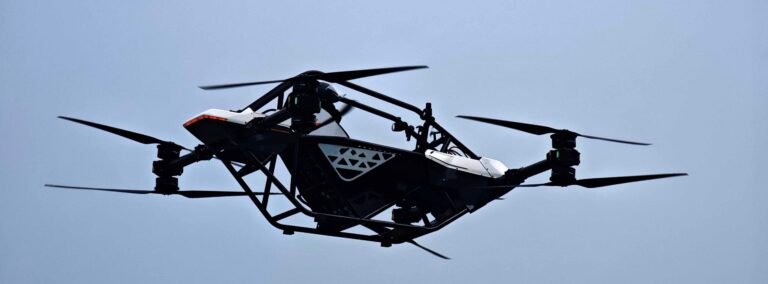
The low-altitude economy should not be understood simply as a new drone market. Its real significance lies in the way near-ground airspace is beginning to become a new operational layer of the economy: a layer where navigation, sensing, logistics, automation, energy, software, and industrial capability converge within a shared execution architecture. In China, this logic is already starting to become visible with considerable clarity.
Introduction
For decades, airspace below 1,000 meters was used only episodically for helicopters, emergency operations, and limited recreational activity; it is now being reframed as an operational layer for economic and public-service activity.
That image is beginning to fade, and in China faster than anywhere else.
This article explains the logic behind it, the model China is building, and what all of this implies for Europe. If you have not yet read the first piece in this series — where the direct experience of flying in Hangzhou serves as a practical entry point into the concept — that is a good place to start before continuing here.
What exactly is the low-altittude economy?
A broader definition than it seems
There is no single global definition, but in China the sector is increasingly framed as economic activity using low-altitude airspace for manned and unmanned aircraft, logistics, inspection, emergency response, and territorial services.
That space, which until recently seemed of little economic use, is beginning to be seen as an additional network for transporting, inspecting, measuring, responding to emergencies, and managing territory more effectively. Just as a road network is not merely asphalt but a structure that connects activities and reduces time, nearby airspace is beginning to emerge as a more flexible and, in certain contexts, more efficient operational layer than existing alternatives.
The drone as a modular platform, not a closed product
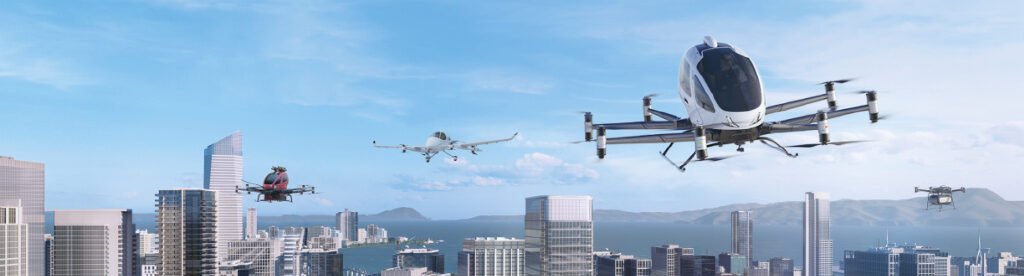
A common mistake in analyzing this field is to treat the drone as a closed product category. It is not. As in robotics — as I explored in my article on robotic execution architecture in China — the drone is best understood as a modular, reconfigurable platform. Its basic structure may remain relatively stable, while payload, sensing, autonomy, connectivity, and final function vary enormously depending on the use case.
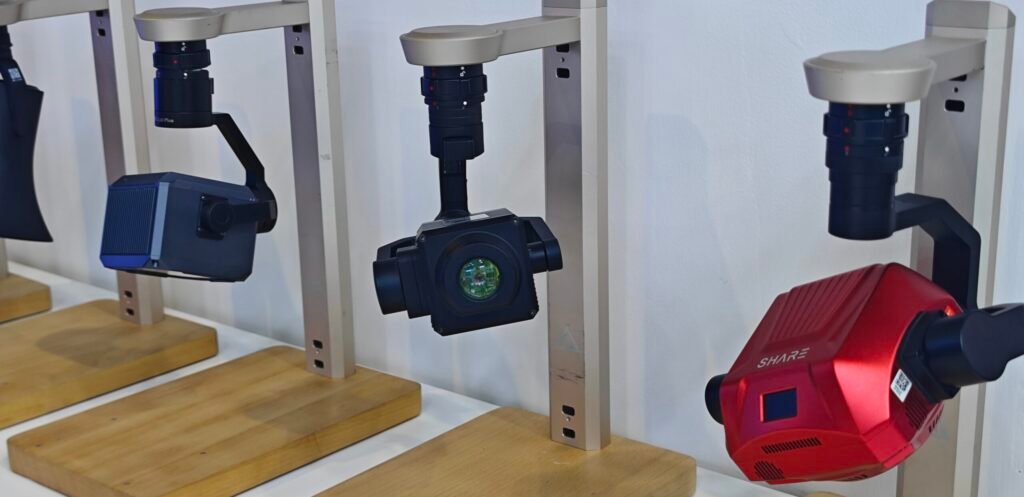
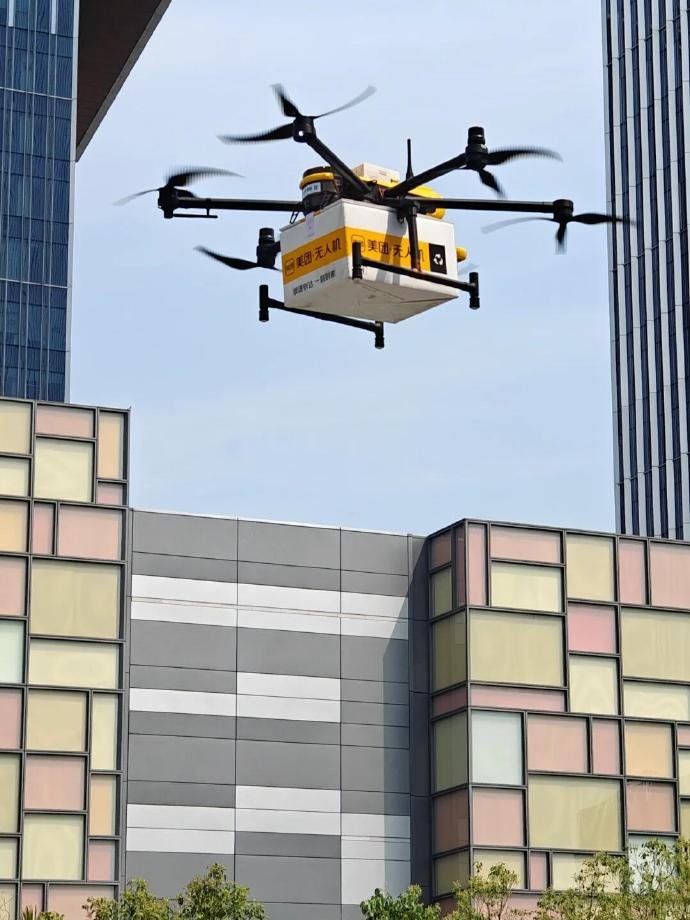
That is why the same technical principle can produce radically different configurations. The same drone can transport an urgent delivery in an urban environment, inspect a dam, spray crops, illuminate a nighttime rescue operation, or lift a person into the air. What matters is not the device itself, but the range of functions it can support.
At what altitude does the low-altitude economy actually operate?
In practice, the sector is commonly described as operating below 1,000 meters, with some Chinese discussions extending the boundary to 3,000 meters depending on mission profile and local regulatory conditions.
Within that space, low-altitude air traffic management systems work with different layers according to aircraft type, system autonomy, and operational risk. In practice, most logistics and governance operations take place below 300 meters.
The convergence changes everything
The low-altitude economy did not arrive overnight. It is the result of the simultaneous maturation of four developments that, on their own, would not have been enough.
The sector’s growth reflects the convergence of electric propulsion, miniaturized perception systems, autonomous navigation software, and dedicated regulatory frameworks.
It is the combination of these four factors that allows us to speak of a sector with real deployment potential, rather than just a collection of promising technologies viewed in isolation.
key idea
The real leap does not lie in drones flying more, but in near-ground airspace beginning to be used as a strategic infrastructure.
The chinese model: from industrial policy to deployed infrastructure
A state priority, not just a market opportunity
In China, the low-altitude economy has become an explicit state-backed industrial priority.
The sector was highlighted in China’s Government Work Report in 2024 and again in 2025, and it was subsequently incorporated into proposals for the 15th Five-Year Plan (2026–2030).
It is not a niche experiment, but a field in which the government has decided to build leadership systematically, combining regulation, public investment, and industrial density.
Official Chinese data show how quickly the sector is expanding. According to the Civil Aviation Administration of China (CAAC), , the low-altitude economy is projected to reach RMB 1.5 trillion by 2025 and RMB 3.5 trillion by 2035. The number of registered drones reached 3.28 million units by the end of 2025, up 20% on the previous year, while cumulative flight hours grew by nearly 70% year on year.
Shenzhen as a laboratory: concrete data
The clearest example of what it means to manage low-altitude airspace as real urban infrastructure is Shenzhen. The city introduced specific regulation for the low-altitude economy in February 2024, becoming the first city in China to do so, and deployed the SILAS platform: a dynamic airspace management system in which operators request flight permissions and the system automatically analyzes conflicts and allocates space.
The results are concrete. In 2024, Shenzhen had 203 active urban air mobility routes and 121 takeoff and landing points. The sector included more than 1,900 companies and generated industrial output of over RMB 21.38 billion, with year-on-year growth of 26.4%. This is not a pilot project. Guangdong Province is scaling the model across its territory.
The EHang case: what a record certification process reveals
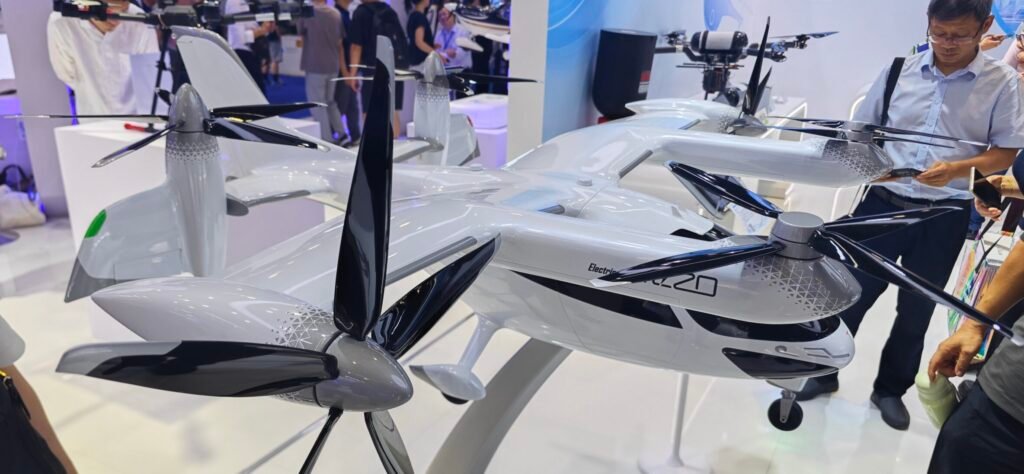
One of the clearest indicators of this field’s maturity in China is EHang’s trajectory. In March 2025, the company completed the full certification cycle for its EH216-S eVTOL: type certificate, production certificate, airworthiness certificate, and finally air operator certificate. It was the first company in the world to achieve this, with commercial flights already in operation in Guangzhou and Hefei.
The process took less than 31 months. European (EASA) and American (FAA) regulators estimate timelines of between five and seven years for equivalent processes. The difference reflects the alignment of regulation, industry, and certification capacity across the same execution ecosystem.It reflects the density of the industrial ecosystem surrounding development: regulation and industry moving in the same direction at compatible speeds. That, in itself, is a structural advantage.
How much is the low-altitude economy market worth in China
The value of the industrial chain reached RMB 506 billion in 2023. It is expected to exceed RMB 1 trillion in 2026 and reach RMB 3.5 trillion by 2035. These are figures that position the field not as a technological niche, but as a new component of national economic infrastructure.
These projections coexist with an operational reality that remains uneven. The low-altitude economy is not equally developed across the country. What can be observed in Shenzhen, Hangzhou, or Shanghai is qualitatively different from what exists in second- or third-tier cities. But the direction — and the speed — are clear.
What should Europe take from this?
U-Space, EASA and the real gap
Europe is not starting from zero. The European Union Aviation Safety Agency (EASA) has developed the U-Space regulatory framework for low-altitude drone operations, and in Spain the first cities — Benidorm and A Coruña — are implementing it through Enaire’s Welcome project. The 2026 regulatory update from AESA aims to harmonize operational scenarios across Europe with stricter requirements for advanced operations.
But there is a real gap in execution speed. Certifying an eVTOL in Europe takes between five and seven years. In China, EHang did it in 31 months. That difference cannot be explained by resources alone. It reflects how the relationship between regulators, manufacturers, and the industrial ecosystem is organized. In China, they move in the same direction and with minimal friction. In Europe, the processes exist, but they remain more fragmented.
The main question for European insitutions
The critical question for a European public administration or company is not whether this field will become relevant — it already is — but what kind of institutional and industrial architecture it wants to build in order to take part in it. The point is not to copy the Chinese model, but to understand which execution principles might be transferable to the European context and which might not.
That question becomes even more concrete when the analysis shifts from mobility to governance. Drones do not only move people and goods. They also perceive, interpret, and transmit information about the environment. That is the terrain explored in the article on the role of drones in smart governance.
Europe shouldn’t try to copy the Chinese model, but it is essential to work on reducing fragmentation between regulation, testing, certification, and commercial deployment.
One final thought
The low-altitude economy does not simply point to a new generation of drones. It points to a different way of building logistics, territorial, and industrial capacity: more aerial, more flexible, and more closely integrated with the real needs of the territory.
Once nearby airspace stops being empty and starts operating as infrastructure, the implications go far beyond transport. And those implications are already beginning to take shape — in more concrete ways than many people assume — in some Chinese cities.
Contact us if you want to learn more about these technologies and the ecosystem that supports them.