
My First Drone Flight:
The Future of Mobility
In brief
Trying two personal flight platforms in Hangzhou did more than bring an emerging technology within reach. It clarified something more important: the low-altitude economy is beginning to take shape in China as a new layer of mobility, logistics, and operational capability.
The field remains at an early stage, but in China the direction of travel is already becoming visible.
For Europe, the relevance lies less in the novelty of personal flight than in the regulatory, industrial, and operational ecosystem required to make it viable.
Introduction
After fourteen years in Hangzhou, I am still struck by how naturally certain technologies stop feeling futuristic here and begin to feel tangible.
A few months ago, I was invited by a drone company to experience firsthand some of its personal flight solutions. What I found was not exactly what I expected. It was not the feeling of touching the future, but something more sober and, in some ways, more revealing. The technology no longer felt distant. It felt like something that works, something with physical weight, something that requires training, planning, regulation, and an entire synchronised ecosystem behind it if it is to scale. That, precisely, is what defines the low-altitude economy in its current phase in China.
The real significance lies less in personal flight itself than in the fact that the surrounding ecosystem — training, certification, airspace management, and operational coordination — that makes it viable.
Two platforms, two operating logics
The multirotor cabin
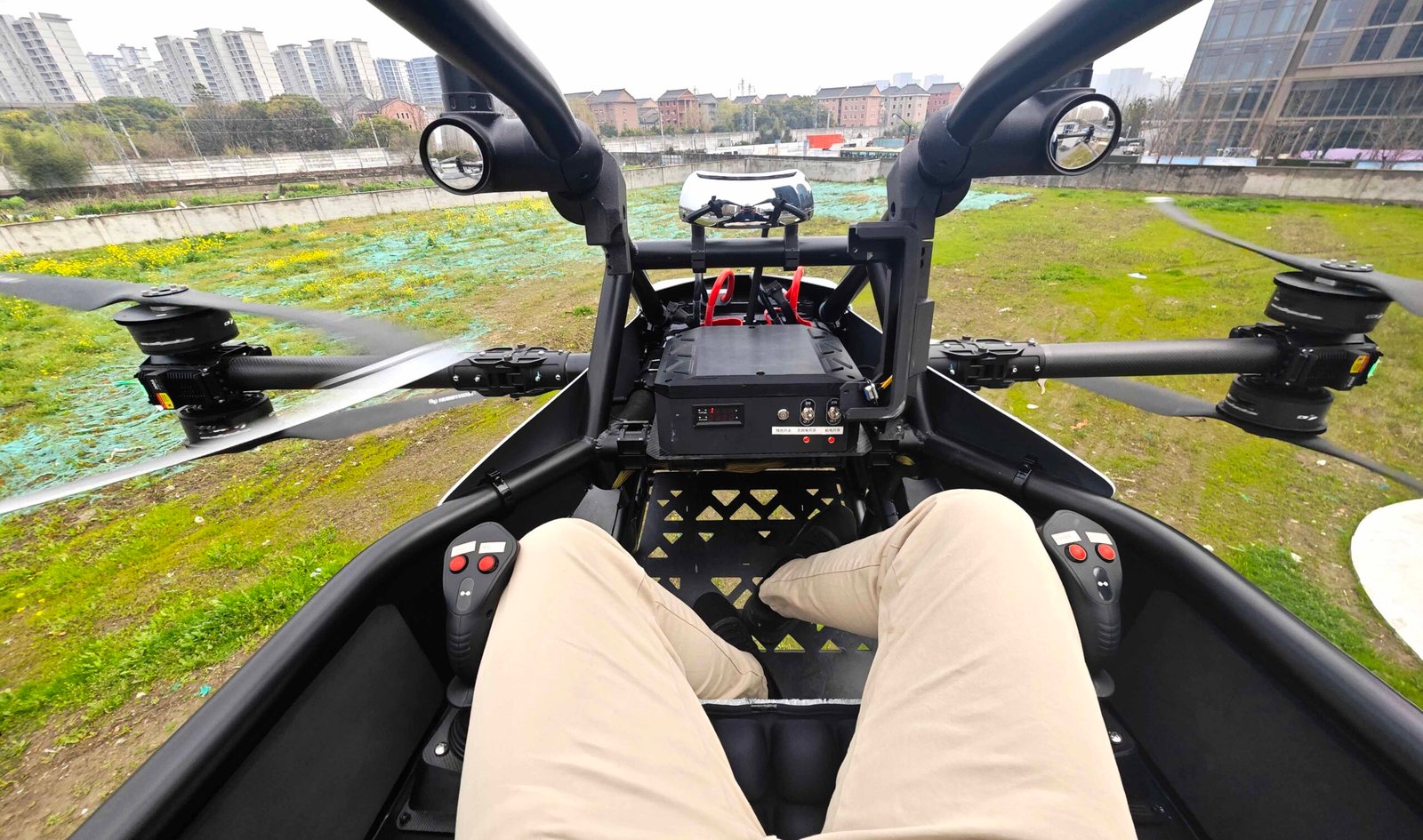
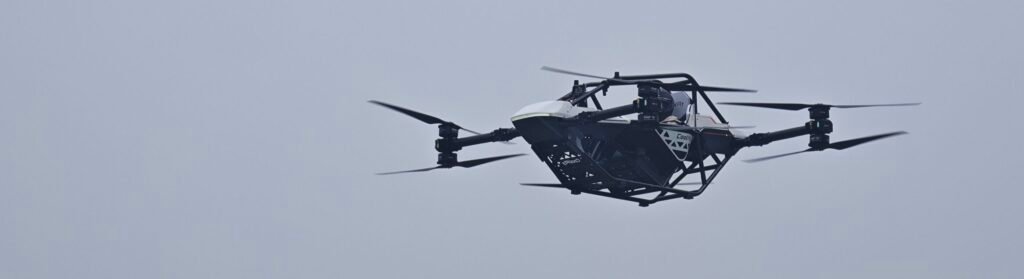
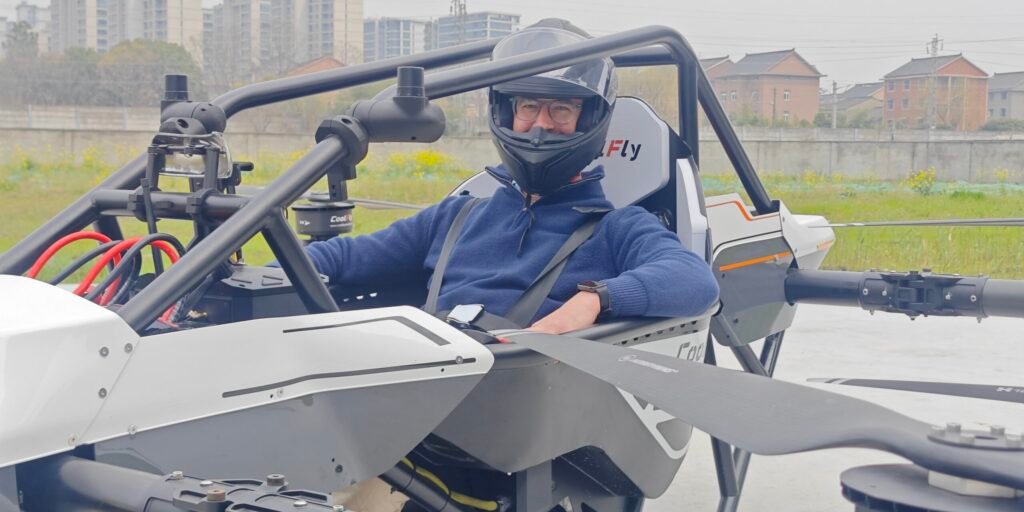
The first aircraft I tried was a multirotor drone with a closed cabin. You sit down, fasten your seat belt, take a deep breath and the ascent begins within seconds.
The initial feeling is hard to describe: a mix of incredulity, strangeness, and fascination, followed by a sense of stability far greater than I had expected. I do suffer from some vertigo, so I had my doubts before takeoff. But once in the air, the sense of balance was solid enough for that unease to fade fairly quickly.
What stays with you after landing, besides the obvious thrill of the flight, is a concrete realization: this no longer feels like a concept or a demo designed to impress. It feels like a real machine that is beginning to find its place. Its significance lies less in novelty than in the fact that it already behaves like a regulated machine in search of a practical role. It is not yet ready for mass use, but it no longer belongs purely to the experimental realm.
The standing platform: the body as a steering mechanism
The second model was different both in concept and in experience. Instead of a closed cabin, it is a platform you ride standing up, holding onto a handlebar. Steering is controlled not with a joystick, but by shifting your body weight, and the safety equipment was mandatory: an airbag jacket — designed to deploy in the event of a sudden loss of altitude — along with a helmet, knee pads, and gloves.
The feeling changes completely: it is more physical, more exposed, and there is far less separation between the pilot and the environment. That is why it struck me as a platform with a different logic: less focused on passenger comfort and more suited to inspection, emergency response, and other operational contexts where operational usefulness matters more than comfort.
That distinction matters because it shows that the same technical base can evolve into very different uses depending on payload, environment, and operating logic.

What do you need to fly a personal transport drone in China?
The process is demanding and deliberately conservative. It requires a theoretical exam and a significant number of flight hours, both in simulators and in controlled environments. The long-term goal is autonomous flight — where the passenger does not control the aircraft but must still be qualified to intervene if the system fails — although for now an external operator remains responsible for the flight. If the cabin is designed for two people, both passengers need certification.
I do not see that complexity as a flaw. On the contrary, it suggests that this field is starting to be treated seriously, with training, certification, and operating rules, rather than just eye-catching prototypes. That seriousness matters. It suggests that, in China, the sector is beginning to move from demonstration to governed deployment.
key idea
What matters most is not the machine itself, but what it anticipates: a new infrastructure for mobility, logistics, and operational capability.
The real challenge is not the aircraft itself
Why regulation and training are the real bottlenecks
What became clearest after the flight was not the technology itself, but everything required for it to scale. I do not mean only physical infrastructure, but training programs, regulatory frameworks, airspace management systems, emergency protocols, certification platforms, and social acceptance.
All of that has to grow at the same pace as the technology — or even ahead of it. In other words, the main bottleneck is not only technical. It is institutional, operational, and regulatory.
In China, that process is already underway, unevenly, but with a recognizable logic behind it. The pieces are appearing: specific regulation, certification programs, and digital platforms for managing low-altitude air traffic. Not everything is solved yet, but the direction of travel is already clear.
From closed product to modular platform
One of the clearest lessons from that visit is that a personal transport drone should not be read as a finished product, but as a platform: a technical base that can be configured very differently depending on payload, onboard sensors, flight autonomy, navigation systems, and final use. The same technical principle that can lift a person into the air can also be applied to urgent logistics, infrastructure inspection, emergency response, or precision agriculture.
That is where the flight experience connects to something broader: the low-altitude economy is not built around a single device, but around a new way of using nearby airspace to move people, equipment, and data.
This is one reason the low-altitude economy should be understood as infrastructure rather than as aviation spectacle.
What the flight reveals about the low-altitude economy
A new layer of mobility, logistics, and operational capacity
The real shift is not simply about adding another machine to the transport system. It is about opening up a different way of moving things across the territory: more flexible, more three-dimensional, and, in certain cases, more useful for transporting materials, collecting data, or responding to emergencies.
In China, there are already fairly clear signs of where this field is heading. They are not yet part of everyday life across the whole country, but they are visible in specific sectors and supported by a level of industrial density that makes development cumulative rather than isolated.
The strategic issue is not personal flight alone, but the emergence of a low-altitude layer that could gradually connect mobility, logistics, inspection, data collection, and emergency response.
Why is Hangzhou a good place to observe this?
Hangzhou has spent years consolidating itself as one of China’s most dynamic technology hubs. It may not be the most visible city to outside observers, but it is one of the most active laboratories for technological and industrial integration. Companies that feel almost routine here would be headline news in many other markets.
That does not mean what you see in Hangzhou represents all of China. It means what you see here often foreshadows what will reach other places later.
That is precisely why Hangzhou is valuable as an observation point: not because it stands for the whole country, but because it often reveals emerging industrial directions early.
One final thought
Getting into a personal transport drone does not by itself transform the way you think about mobility. But it does add something you cannot get any other way: the concreteness of having felt the balance, the noise, the weight of the safety system, and the natural ease with which the operator handled something that, ten years ago, would have looked like science fiction.
That concreteness matters. Because once technology stops being abstract, the questions change too. The question is no longer, “Is this possible?” but “What does it take for this to work in the real world?” And that second question — about ecosystems, regulation, data, and infrastructure — is what the broader low-altitude economy ultimately forces us to confront. I explore that broader layer in the next article on the low-altitude economy in China.
Drones are also beginning to perceive, interpret, and transmit information about the environment. That dimension — the drone as a tool of territorial governance — is the subject of my article on the role of drones in smart governance.
Get in touch if you would like to explore what China’s low-altitude ecosystem may reveal for mobility, logistics, and territorial governance in Europe.